
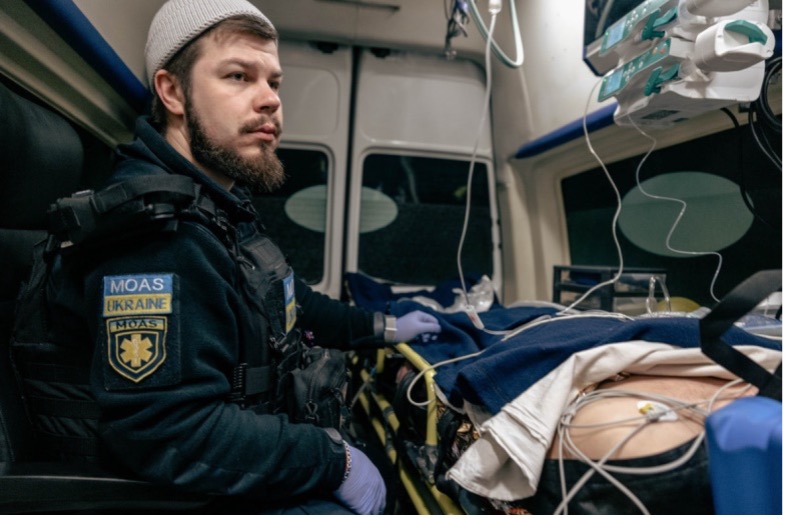
We’ve had to grow up not in years, but in months, sometimes even hours,” Yevhenii Lozinskyi, 25, MOAS ambulance driver
Valletta, Malta – August 20, 2025 — Moving past the celebrations of International Youth Day (August 12), MOAS, the Malta-based international humanitarian organisation, turns the spotlight on a group of extraordinary young people whose youth has been dramatically redefined by war.
In Ukraine, the concept of youth as a period of growth and carefree exploration has been replaced by a harsh reality: responsibility, sacrifice, and survival. At the core of MOAS’s frontline operations are young medics, drivers, and paramedics—many under 30—who have taken on roles that demand bravery well beyond their years.
To recognise their invaluable work, MOAS shares the personal stories of four young team members who embody the strength, hope, and urgency of a generation shaped by war. These are not just stories of resilience: they are stories of leadership. These young Ukrainians are not waiting for peace to reclaim their youth; they are building the future by saving lives every day.
“This pain became my purpose”: Yevhenii Solod, 26
When Russia launched its full-scale invasion in February 2022, for Yevhenii Solod, the shift from peace to war was swift and complete. “I used to live a calm, peaceful life. In my home, surrounded by loved ones and simple joys. But one day, everything was suddenly gone.” Faced with this abrupt loss and witnessing the suffering caused by the invasion, he knew he wanted to help in some way.
He learned about MOAS and made a swift decision. “I told my loved ones I was joining MOAS and clearly stated I didn’t want to hear any objections.” Yevhenii viewed his new role not merely as a job, but as a mission. “I didn’t see MOAS as just an organisation, I saw a real family.”
One night, a missile strike hit their location. “There was fire, smoke, panic. My first thought was about the others and how to save them, where to run. That day only strengthened my motivation.” Despite everything, he continues to study, now training to become a rehabilitation therapist to support wounded soldiers.
From Stage to Frontline: Yevhenii Lozinskyi, 25
Before the invasion, Yevhenii Lozinskyi was training to become an actor. He had already taken part in local productions and was a member of a stunt team. But after the invasion, he felt he had no choice but to change that path. “I couldn’t stay on the sidelines. I felt the need to act, to do something for my country.”
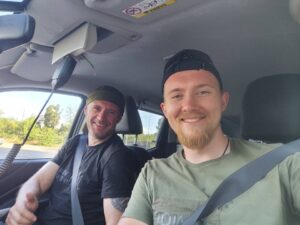
He joined the local Territorial Defence Forces. Later, once Kyiv had been defended and the unit was no longer needed, he looked for a new way to contribute. A friend mentioned MOAS to him, and he quickly applied. “As soon as I got the offer, I was eager to join.”
Yevhenii became a driver on medical evacuation missions. Long hours, high stress, and constant danger. “At first, it was tough adjusting to little sleep and long hours behind the wheel. But what helped was knowing what our soldiers faced on the front line. That kept me going and pushed me to do my job even more diligently.”
After the war, he wants to go back to his profession and help rebuild the Ukrainian media industry, living with his family and without fear.
Holding the Line with Skill and Heart: Mykyta Buriak, 25
Before the war, Mykyta Buriak was working in emergency medical services. His days were busy, but they followed a rhythm. That changed with the full-scale invasion.
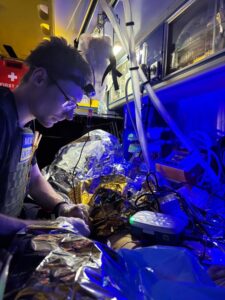
Mykyta kept working as a medic, but the nature of the job changed overnight. Emergencies were no longer accidents or isolated events; they became constant. Every day brought new casualties. The pressure increased, but so did his sense of responsibility.
Then, one day outside a hospital, he encountered MOAS medics during a patient handover.
“They were calm, confident, even in such a high-stress situation. I realized I want to be part of this. I want to be where I can help save those who are protecting us.” In April 2024, he officially became part of the MOAS team.
Each mission is physically demanding and emotionally intense. But one in particular has stayed with him. The evacuation of a 22-year-old soldier, critically wounded, with a tattoo that read “Free Youth.”
“He could have been studying, building a career, making plans for the future. But he chose to defend his country instead.” The soldier had lost several limbs. His injuries were devastating, but what stayed with Mykyta wasn’t just the trauma, but also the meaning behind that tattoo: “It was a reminder of everything that’s been stolen from our generation. Freedom, safety, time.”
The war has left its mark on Mykyta, too. It changed how he saw his role and how he saw himself. “You start to see things differently. You value small moments. You stop wasting time. There’s no space for things that don’t matter.”
A Life Interrupted, a Mission Accepted: Alina Serhiivna Bilous, 29
In March 2022, Alina Bilous saw a call for medics to join MOAS. She signed up right away. “The war disrupted my way of life and daily routine, crossed out all my plans. It limited the chance to connect in person with family and friends. It restricted my freedom.” Now a team leader on evacuations, Alina says the work has made her more serious, more focused, and more protective of those around her. “I carry the responsibility not only for the wounded, but for my whole team. Their lives and health, their morale and mental state.”
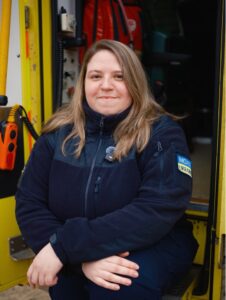 She’s learned to value the present. “A moment of conversation, friendship, a long-awaited meeting, a warm talk, or a genuine hug. We’ve learned to truly appreciate the here and now, because tomorrow, unfortunately, might not come.”
Why It Matters
While many youth-focused campaigns focus on empowerment, education, and opportunity, the reality in Ukraine underscores a more complex truth: for some, youth is a battlefield. And yet, even amid trauma, the desire to protect, rebuild, and hope endures.
“I hope to live. I hope my friends and loved ones stay alive and well,” says Mykyta.
“To build our life together again and make up for the time we’ve lost,” adds Yevhenii Lozinskyi.
We’re not asking for pity,” says Yevhenii Solod. “We want people to understand that we’re fighting for our right to live, to be together, to feel safe in our own country.”
As Ukraine’s youth continue to shoulder impossible burdens, MOAS calls on the international community not only to celebrate young people—but to stand with them.
Support Their Mission
To support the work of these courageous young people, donate at: www.moas.eu/donate