
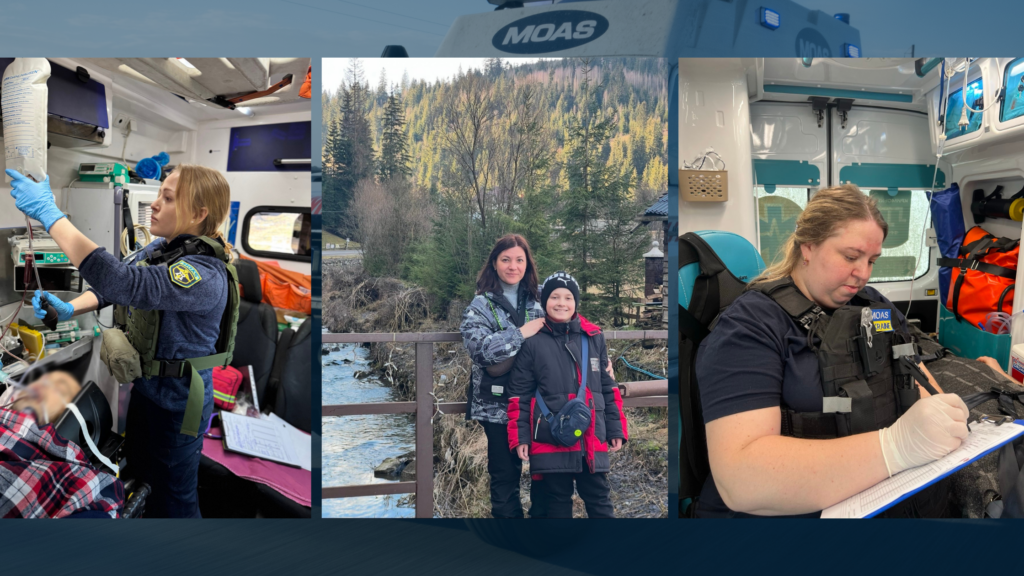
In Ukraine’s war‑scarred East, where the sound of engines from evacuation vehicles blends with the distant echo of shelling, three women carry out work that demands precision, courage and an unshakeable sense of purpose. They lead teams, stabilise the wounded and make life‑or‑death decisions in seconds, all while navigating a frontline environment still largely shaped by male presence and military culture.
This month, as the world reflects on the role of women in society, we turn our attention to the women of MOAS Ukraine who serve on the frontline every day. Their stories are not about heroism in the abstract. They are about competence, resilience, and the quiet determination to save lives in the harshest conditions.
They do not ask to be celebrated as exceptional. They simply ask to be seen as professionals—equal, capable, and deeply human.
Inna: A Doctor Driven by Duty and Clarity of Purpose
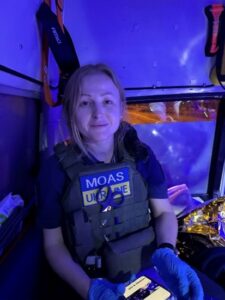
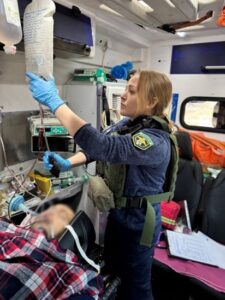
Inna, an anaesthesiologist and medical director within MOAS Ukraine, describes her work with characteristic brevity and clarity. Her definition of success is direct: “A life saved.”
She joined the frontline medical effort out of a desire to serve her country in the way she knew best, through medicine. In her view, gender has no place in the conversation: “There is no difference in gender. Today in Ukraine, everyone must take part in the war. Some with weapons, medics by helping the wounded.”
Her team, she says, is professional, respectful and motivated. She has never faced discrimination, nor does she dwell on the idea of being a woman in a male environment. Her focus is on competence, discipline and the mission.
She begins her recovery from a difficult shift with the simplest but most vital step: sleep; and then turns to sport, which helps her regain steadiness in both body and mind. When it comes to emotional wellbeing, she knows exactly where to seek support and appreciates how many mental‑health platforms are now available across Ukraine, ready to be used whenever the need arises.
Inna speaks with a calm, grounded clarity: she is pragmatic, steady and shaped by a deep sense of duty. Her presence reflects the quiet, unwavering professionalism that keeps the medical evacuation system steady even in its most pressured moments.
Alina: Leading With Calm, Precision and Humanity
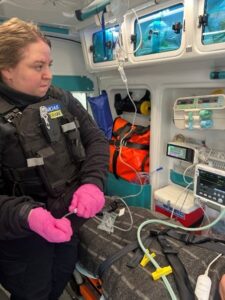
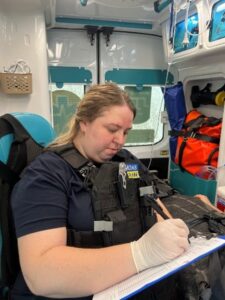
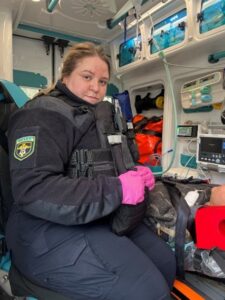
As a unit leader, Alina Bilous oversees one of MOAS Ukraine’s evacuation directions. Her role is a blend of coordination, leadership and constant situational awareness. She manages crews, ensures smooth communication with medics, and keeps the entire evacuation chain functioning as one.
For her, the recipe for success is simple and profound: “When the team works like a single organism. Everyone in their place, everyone ready to support each other.”
Alina stepped into this work driven by a desire to provide the highest possible level of medical care to wounded soldiers. She speaks of her team with pride, not as a commander issuing orders, but as someone who sees the value and dignity in every role. Working in a male‑dominated environment has never been a barrier for her. “Everyone is focused on professionalism and success,” she says. “We all have our responsibilities, and we find ways to understand each other and compromise when needed.”
What she wishes people understood about women on the frontline is not about strength, but about balance: “We work in war conditions on the same level as others. We don’t see our families, we don’t make long‑term plans. And still, we want to keep our femininity, our tenderness, our love for beauty. To stay human despite the brutality around us.”
After difficult shifts, she resets with sleep, a slow cup of coffee, a walk in the park when possible, or a call home: small rituals that help her hold onto normality.
Natalia: The Medic Who Brings Humanity Into the Hardest Moments
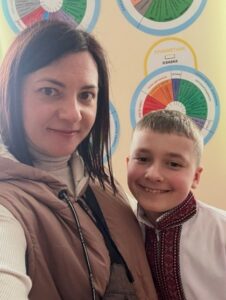
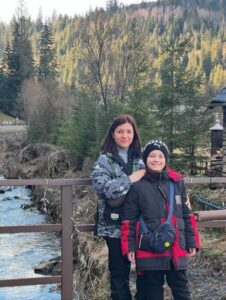
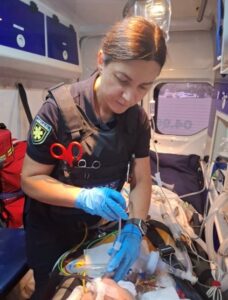
For Natalia Tarasiuk, a MOAS Ukraine medic, her role is defined by presence, being there at the exact moment when someone’s life depends on speed, clarity and skill.
“This is work where there is no room for confusion, but there is room for humanity,” she says. During evacuations, she must remain composed even when surrounded by pain and urgency. Fear has no place in those moments; only the algorithm of actions does.
Success, for her, is the quiet after the storm, when a patient is handed over stable, when the team knows they have preserved a chance. Sometimes success is simply knowing she did everything possible, without panic, without mistakes.
Natalia joined this work at the start of the full‑scale invasion, driven by a deep internal sense that she had to be where the need was greatest. Over time, the work has shaped her worldview, teaching her to value life in its simplest forms: breath, movement, a word, an embrace.
Working in a mostly male environment requires confidence and professionalism, she says. But competence dissolves stereotypes quickly: “When the team sees your responsibility and skill, any biases disappear.”
She is honest about the emotional weight of the job. It cannot be fully separated from personal life, but she finds grounding in her roles as a mother, daughter and woman. Conversations with her son, everyday routines and time with loved ones help her return to herself.
To decompress, she turns to physical activity, reading, especially psychology and literature on trauma, and the presence of family. For her, caring for mental health is not a weakness but a responsibility: “It’s as important as professional skills.”
Women Who Carry the Weight of War With Strength and Grace
Inna, Alina and Natalia represent three different paths, three different temperaments and one shared truth: women are not exceptions on the frontline. They are essential.
They lead teams, make critical decisions and bring a depth of empathy that strengthens the entire mission. They carry the emotional and physical weight of war while holding onto their humanity, sometimes fiercely, sometimes quietly, but always with purpose.
Their stories remind us that women in conflict zones are not symbols. They are professionals. They are caregivers. They are leaders. And they are human beings navigating extraordinary circumstances with courage that rarely makes headlines.
This month, and every month, MOAS honours their work, their resilience and the lives they help save.
Your support can make a difference. Please consider donating to help us continue our missions and save lives. Visit www.moas.eu/donate to contribute. For more updates on our work, follow us on social media, sign up for our newsletter, or contact us at [email protected].
Disclaimer: “Funded by the European Union. Views and opinions expressed are however those of the author(s) only and do not necessarily reflect those of the European Union or the European Education and Culture Executive Agency (EACEA). Neither the European Union nor EACEA can be held responsible for them.”