
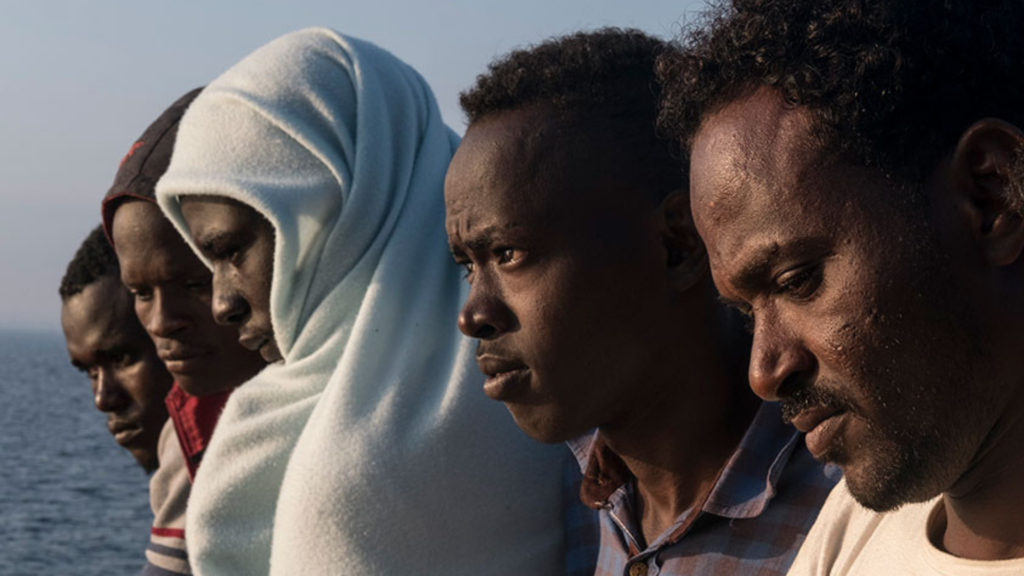
When war closes roads, destroys communities and leaves civilians with no safe way forward, people do not stop moving. They keep searching for safety, even when the only path left leads across water.
Across the world, conflicts have repeatedly shown that dangerous sea crossings are not the beginning of displacement; they are its consequence.
For countless families, the decision to cross water is made only after safer routes have become inaccessible or impossible.
Understanding why people are forced onto the world’s most dangerous waterways is essential if we are to respond with humanity rather than judgement.
War Closes Land Routes. Water Becomes the Only Escape
Conflict closes the pathways to safety. Roads that once connected communities become frontlines, bridges are destroyed, transport networks collapse and checkpoints multiply. Active fighting, landmines and shifting lines of control make ordinary journeys life-threatening.
For civilians, the result is simple but devastating: the routes they would normally use to escape no longer exist.
Parents trying to protect their children, elderly people seeking medical care and families fleeing violence often find themselves with only one option remaining. When every road is blocked by conflict, rivers, lakes and seas become the last available route to safety.
People rarely choose to cross water because it is safe, they do so because every alternative has disappeared.
Water Routes Are Not Chosen. They Are Forced.
No family willingly boards an overcrowded, unseaworthy vessel with their children if a safe journey is available.
The decision to cross water is usually made after months or even years of displacement, repeated violence and impossible choices. It reflects desperation rather than preference.
Whether crossing the Mediterranean, the Andaman Sea or other dangerous waterways, displaced people often face the same reality: smugglers profit because legal pathways are absent, while conflict continues to narrow every remaining option.
The journey across water is therefore not the crisis itself. It is the final stage of a much longer humanitarian emergency that began with war, persecution or disaster.
Recognising this changes the conversation. Rather than asking why people take such risks, we should ask why they were left with no safer choice.
Understanding Drowning Through a Humanitarian Lens
Deaths at sea are often described as accidents of navigation or border management. In reality, they are humanitarian tragedies.
People drown because they are forced onto unsafe boats, denied safe routes and left with impossible decisions. The water may be where lives are lost, but the causes lie on land.
Every life lost at sea represents a failure to protect civilians before they reached the shoreline.
This is why search and rescue cannot be viewed simply as a maritime responsibility. Saving lives on the water is part of a broader humanitarian obligation to protect people fleeing conflict and violence.
The principles are the same whether responding on land or at sea: preserve life, reduce suffering and uphold human dignity.
How MOAS’ Maritime Experience Shapes Our Advocacy Today
MOAS was founded on the belief that no one should die simply because they were forced to flee.
Our experience conducting search and rescue missions at sea demonstrated that humanitarian action begins long before a rescue takes place. It starts with understanding why people are compelled to undertake dangerous journeys in the first place.
Today, that lesson remains central to everything we do.
Whether operating intensive care ambulances in Ukraine or responding to other humanitarian emergencies, we continue to advocate for the protection of civilians, safe humanitarian access and the fundamental right to life.
Your support can make a difference. Please consider donating to help us continue our missions and save lives. Visit www.moas.eu/donate to contribute. For more updates on our work, follow us on social media, sign up for our newsletter, or contact us at [email protected].
Disclaimer: “Funded by the European Union. Views and opinions expressed are however those of the author(s) only and do not necessarily reflect those of the European Union or the European Education and Culture Executive Agency (EACEA). Neither the European Union nor EACEA can be held responsible for them.”