
What Medical Neutrality Means
The idea of medical neutrality dates back to 1862, when Henry Dunant, funder of the International Committee of the Red Cross, published A Memory of Solferino. In his account of the Solferino battle (1859), based in nowadays Italy, he described thousands of wounded soldiers abandoned on the field after their armies retreated. With no protected medical zones and no legal distinction between medics and combatants, the wounded often waited days for help. After Solferino, it took the army six days to collect ten thousand injured soldiers.
Local civilians in Castiglione were left to care for far more wounded than they could possibly manage. Dunant’s book exposed this humanitarian failure to the wider public and to political leaders. His proposals eventually shaped the First Geneva Convention (1864), signed by 12 states, laying the foundation for what we now call medical neutrality.
Today, medical neutrality means:
- Medical personnel and facilities must be protected and allowed to operate.
- Treating patients must never be punished, regardless of their identity or affiliation.
- Care must be provided solely on the basis of medical need.
- Medical facilities must be used exclusively for medical purposes.
In essence: medicine must remain separate from politics and war.
Where We Are Now
The World Health Organization has documented at least 2,881 attacks on healthcare since the start of the full‑scale invasion of Ukraine. In 2025 alone, attacks increased by 20% compared to the previous year, and strikes on medical warehouses tripled. While frontline regions face the highest concentration of incidents, long‑range missiles and drones now threaten medical facilities across the entire country.
Recent MOAS frontline reports describe attacks on an ambulance evacuating wounded soldiers and on another transporting injured civilians, direct violations of the core rules of medical neutrality.
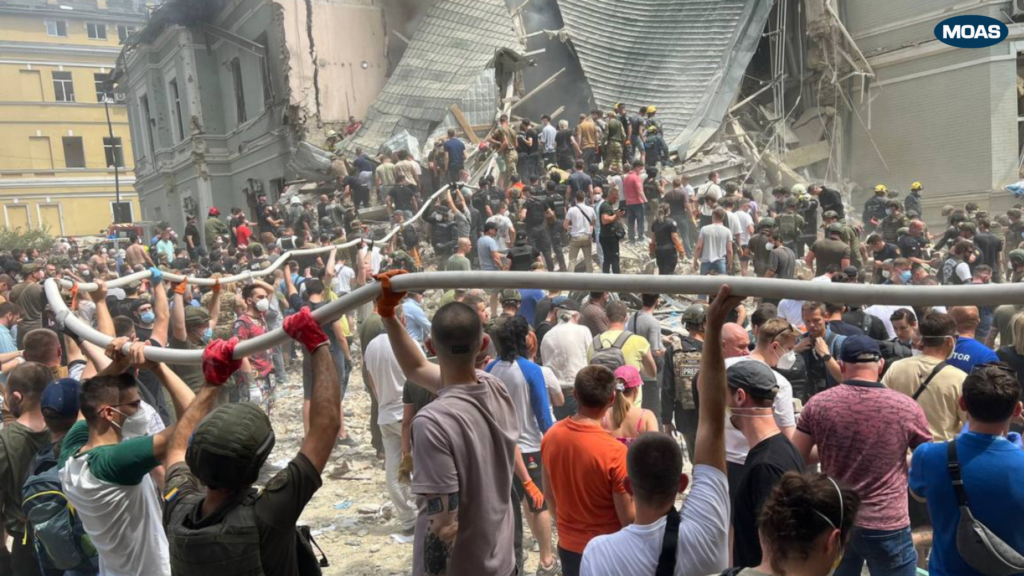
One of the most devastating incidents was the missile strike on Okhmatdyt, Ukraine’s largest children’s hospital. Intensive care units, oncology and surgical departments were severely damaged; toxicology and traumatology wards were destroyed. Three children were undergoing heart surgery at the time of the strike. One child evacuated from an ICU later died in another hospital.
The Human Impact
These attacks have pushed Ukraine’s healthcare system to the brink:
- 8 in 10 people report being unable to access the medicines they need.
- Demand for trauma care, burns treatment, rehabilitation, and mental health support has surged.
- Costs for chronic illness care have risen sharply.
- Overall health has deteriorated nationwide, with 59% of people in frontline areas describing their health as poor or very poor.
In frontline communities where clinics no longer function, trained community health workers now go door‑to‑door to assess needs, monitor chronic conditions, provide health education and offer basic psychological support. In Donetsk region alone, 46% of health facilities are non‑functional or only partially operational.
Attacks on civilian infrastructure further undermine care. Hospitals depend on uninterrupted electricity, water and heating to operate safely, all of which are frequently disrupted.
There is also documented evidence of the militarization of medical facilities by Russian forces. During the first two years of the full‑scale invasion, 87 such incidents were recorded. In at least 22 cases, patients and staff were evicted; in at least 9, Russian forces reportedly launched attacks from inside medical facilities. Medical supplies and equipment were often seized.
Since the start of the war, at least 233 health workers and patients have been killed, and 930 injured, in attacks on healthcare.
Buildings and supply chains can eventually be rebuilt. Lives cannot.
Two centuries after Dunant’s call to protect the wounded, the same fundamental principles are being violated. Medical neutrality, the idea that healthcare must remain outside the logic of war, is not a historical concept. It is a lifesaving obligation and it is being tested every day.
Your support can make a difference. Please consider donating to help us continue our missions and save lives. Visit www.moas.eu/donate to contribute. For more updates on our work, follow us on social media, sign up for our newsletter, or contact us at [email protected].


Disclaimer: “Funded by the European Union. Views and opinions expressed are however those of the author(s) only and do not necessarily reflect those of the European Union or the European Education and Culture Executive Agency (EACEA). Neither the European Union nor EACEA can be held responsible for them.”