
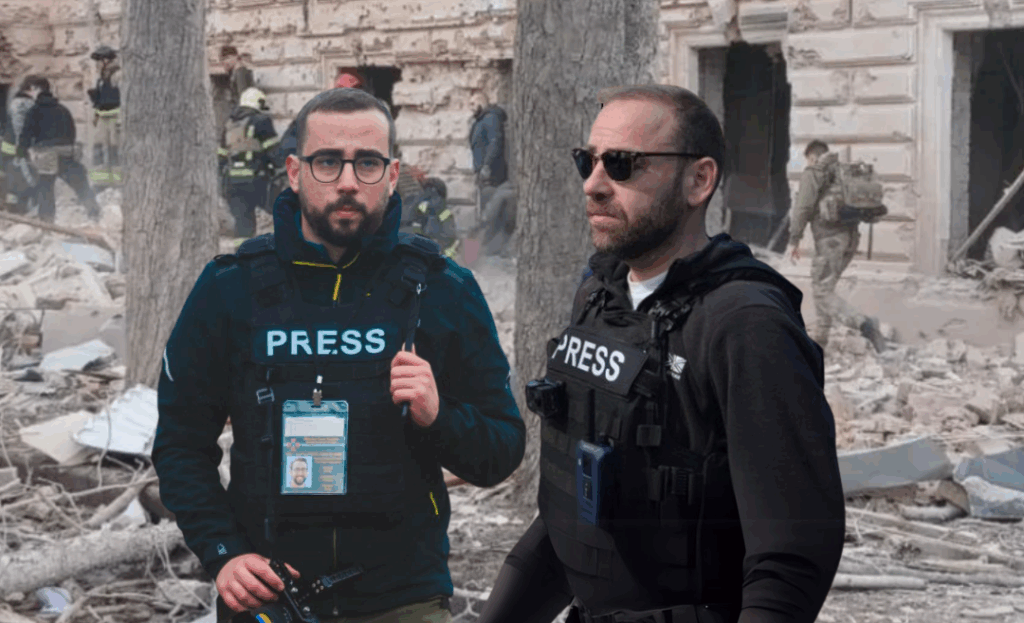
In times of war, the camera becomes more than a tool, it’s a lifeline to truth, a witness to suffering, and sometimes the only remaining record of human resilience. In “Hope Under Fire,” the new fundraising MOAS multimedia fundraising project set in war-torn Ukraine, filmmakers Neil Camilleri and Giuseppe Attard embed with a frontline medical evacuation team to capture three deeply personal stories of courage and compassion.
As veteran photojournalists and visual storytellers, they have covered a wide range of topics, from breaking news to conflict zones. But this assignment – shadowing a doctor, a driver, and a paramedic risking their lives daily to evacuate the wounded – pushed them to the emotional and ethical edge of their profession.
In this interview, Neil Camilleri reflects on the making of the multimedia project, the moral weight of bearing witness, and what it truly means to capture humanity when the world is falling apart.
Let’s start with the experience in Ukraine. How did you prepare to embed with the MOAS team on such a dangerous mission?
The difference between this experience and the preceding ones was that, in this case, MOAS handled most of the logistical challenges for us. While we usually have to find on-the-ground contacts, the MOAS team organised everything down to the last detail. It was much easier knowing that we were going to be picked up at the train station and taken to the base, that food and sleeping arrangements had been taken care of by the team. MOAS even provided us with protective equipment – helmets and ballistic vests – which meant we did not have to carry extra weight from Malta.
Before we set off, we had several meetings with the team in Malta and Ukraine, during which we discussed our plan, the challenges we would face, and the restrictions that might apply to filming patients and sensitive locations.
What are the biggest logistical or emotional challenges while filming in active conflict zones? How do you protect yourselves physically and mentally while working on the frontlines?
The biggest challenge is being prepared for the unknown, which means you must be ready for several different scenarios. In frontline areas, we may lack electricity, so we need to ensure we stock up on batteries and power banks. Out there, you cannot quickly pop to a shop to buy extra SD cards or a charger, so we must ensure we’re carrying everything we need. At the same time, we need to travel as light as possible, making this a very delicate balancing act. In addition to all the filming equipment, there is also the protective gear, clothing, and other necessities we will require on a daily basis.
Travelling to and from, as well as inside Ukraine, is also long and tiring. We usually travel on night trains, so as not to waste daytime. However, this means that we often arrive at a location already feeling drained.
We also need to prepare for a scenario in which an attack on our location or nearby could disrupt our plans, so it’s wise to have Plans B and C ready; however, most decisions are made on the fly.
To protect ourselves physically, we do this by wearing protective equipment and avoiding unnecessary risks. Most of it comes from experience. It’s essential to always listen to what the locals are telling us and to recognise the distinct sounds of incoming and outgoing artillery fire. We must always be vigilant for drones and stay on the roads to avoid potential dangers from minefields. We do not take risks just to have better shots. Safety always comes first. Knowledge of first aid is always helpful. While we were travelling in an ambulance with three professional medics, we still carried our personal first aid kit, including tourniquets.
As to protecting myself emotionally, I think this is something everyone deals with differently, and it also depends on experience. I have been a journalist for 20 years and I have seen a lot – traffic accidents, fireworks factory explosions, murders – and these have hardened me a bit.
While I’m filming, I instinctively block out all emotions and carry on. There are times when the things I see affect me later, during quiet hours. Seeing gravely wounded Ukrainian soldiers in front of me in the ambulance affects me – I have family members who are fighting in this war and who are not so different from the guys we transported. But I try not to think about these things. I have a job to do and emotions cannot come in the way of that.
Can you describe a moment during filming that changed your perspective or stayed with you long after?
There were many such moments. One of them is when a soldier who had just lost both hands to a drone attack turned to us in the ambulance and inquired about our camera. He said he had one just like it in the trench, and he hoped he would be able to take great shots with it. It was the most surreal conversation in the most surreal setting.
Another was the first time we went for breakfast in a nearby hospital building. There was a shell crater in the ground and splinter holes on the walls and windows of the building. We were told that just a few months before, a medic was killed there as he was walking inside the building to get some food .. just like we were doing.
But the most powerful moment for me was during the interviews, when I asked the team members why they chose to be here, doing this job. Their sense of duty and patriotism really moved me.
How did you build trust with the doctor, driver, and paramedic featured in the documentary?
This was very easy to do since the team welcomed us and opened up to us right from the start. Inna, Ihor and Nataliia are wonderful, kindhearted people, and they immediately made us feel welcome. While I was initially scared to intrude on their personal space, they did not mind us at all. We slept in the same room, ate meals together, joked and spoke about Malta and Ukraine. We played with the dog or just spent time on our phones. It felt very natural, and by the end of the trip, I felt that we had already developed a bond with them. It was one of those things where three days feel like three weeks, in a good way.
I really hope we meet again.
How do you ensure dignity and humanity are preserved in such extreme and vulnerable situations? Where do you draw the ethical line when documenting people in distress?
We need to portray war in its raw and brutal form to convey a powerful message to our audience and, hopefully, to decision-makers. But when it comes to covering medical evacuations, we have a duty to protect the identity and dignity of the patients. We film with respect, from a distance, so as not to distress people who are going through a horrible experience. In cases where it is impossible to avoid filming faces, we blur them to protect their identity, keeping in mind that these are not only patients but also serving military personnel.
What do you think is misunderstood about photojournalism in conflict settings?
Some people think that this is a glamorous job that we do for the money or the popularity. That cannot be further from the truth. It’s often a thankless job which we only do out of a sense of duty and passion. The list of dangers is endless, and the stress of embarking on a trip like this is indescribable.
Our trips to Ukraine are not like some action movie where it’s nothing but explosions, missiles and fighter jets. A lot of time is spent travelling or just waiting for something to happen. When it does, we go into overdrive, making sure to document everything as thoroughly as possible while following the rules and adhering to safety measures. At times, it can be a bit overwhelming.
Do you see yourselves more as witnesses, artists, or advocates?
I think it’s a mix of the three. Artists in the sense that we can be creative to convey a powerful message, witnesses in that we are there seeing with our own eyes and documenting the reality on the ground, and advocates because, through our work, we are showing the suffering of the Ukrainian people and bringing it to a global level, hopefully to the extent where we can influence opinions and politics.
What role do you think visual media should play in shaping public opinion or influencing humanitarian action?
Unfortunately, we live in a world where disinformation grows by the second. We also live in a world where visual media is the most popular form of communication. By using this medium to bring to our audience the reality of Ukraine, its people, and organisations like MOAS, we are educating people and presenting to them the realities of war, rather than the conspiracy theories that abound on social media platforms.
In a world saturated with content, what still makes a story powerful or urgent?
The human element of a story will always remain the most important one. By humanising our subjects and showing that they are people like you and me, we can engage more strongly with our audience. That is why the human element is the core aspect of our documentary work. We are not interested in geopolitics or politicians; instead, we film and document stories at the people level. I believe this is why the documentaries we have produced in Ukraine thus far have been so well received by the public.
Your support can make a difference. Please consider donating to help us continue our missions and save lives. Visit www.moas.eu/donate to contribute. For more updates on our work, follow us on social media, sign up for our newsletter, or contact us at [email protected].