
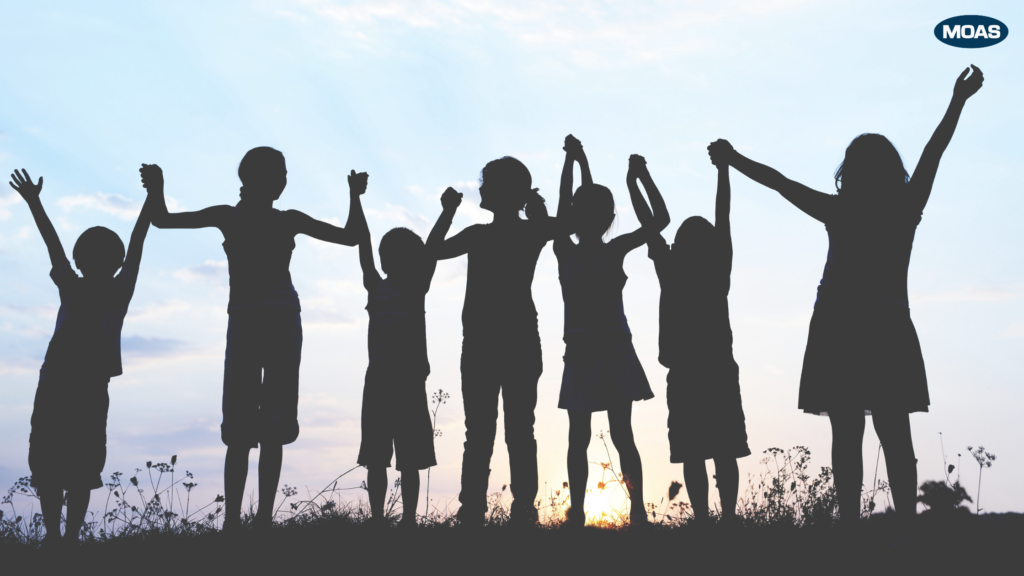
Some have been in Malta for years, some for months. One of them (7 y.o.) wants to be a lawyer to help out her mom in case she needs support, one (10 y.o.) wants to be an athlete and another one (10 y.o.) wants to be an artist because she mainly expresses herself through drawings.
Child migrants are defined as “people aged 18 or under living in a country other than the one where they were born in”. According to UNICEF, there are 36 million child migrants around the world, a number that keeps increasing more and more.
These kids bring with them not only traumas and difficult backgrounds, but dreams, hopes, a favourite toy and fun memories: “When I asked the kids about when they moved to another country, most of them did not know. This is what I admire of kids: they live in the moment, bearing some of the hardest stories I have ever heard as if it is something normal” shared one of our volunteers, who has been working with child migrants for years.
Although considered as vulnerable, child migrants can be considered as role models from adults, teaching us resilience, optimism, happiness.
Little Young Adults
The impact of migration on children is enormous; according to several studies, we can divide the consequences of moving to another country in three different categories, based on the situation of the child: children who were left behind by a parent (in their country of origin), unaccompanied minors and children who migrated with their families. For this blog, we will focus on those children who moved with their families.
Research shows that children who migrate with their families often become the only bridge between home and the host society. Bureaucracy, healthcare, school communication, and daily errands frequently fall on their shoulders, as they are sometimes the only ones who speak the local language fluently. As a result, they take on an adult level of responsibilityfar too early, acting not only as translators but as cultural mediators, exposed to concerns no child should have to navigate.
However, language barriers are a true obstacle children experience when they first move to a new country; our volunteer witnessed the consequences of it during her activities: “I remember a little girl I worked with; she was the last one arrived at the centre, and her level of the local language was really low. Moreover, she was shy and calm, making it hard for her to socialise. Once she confessed that the other kids bully her, calling her “nerd” because she likes to draw and she is sometimes in her own world”. When in a group of children there is a kid who can’t understand the local language, they are more prone to experience exclusion, frustration, sometimes bullying.
Not only language barriers but also legal obstacles deepen these inequalities. Children without a regular legal status often struggle to access essential social services such as healthcare, widening the gap between them and peers who hold documented status.
From an early age, they face cultural shocks and grow up in a constant limbo, seen as foreigners both in their country of origin and in the country where they live. This double displacement can generate a profound sense of social exclusion: they feel they belong nowhere, and everywhere they go they are treated as ‘different’. It becomes yet another layer of exclusion added to an already heavy burden.
Final Thoughts: Little Role Models
Children are beings to be protected and nurtured; they embody our collective future. Those who have experienced migration carry an extraordinary potential, shaped by resilience, adaptability, and a unique understanding of multiple worlds, that we must recognise and value.
Child migrants are first of all children; they have dreams, their own interest, opinions, their favourite subject and a favourite food. Children themselves can teach us how to be optimistic and have dreams when we are adults, to never stop having a goal that pushes us to improve ourselves.
In addition to that, these kids have a bigger emotional background, sometimes harder pasts to deal with: “Once a child, 7 years old, told me her mom escaped from her violent husband, bringing her and her brother with her. They took a boat and crossed the Mediterranean when her brother was few years old. Things like this are hard to hear, however she was telling me this story as if it was something everyone went through. Unimaginable”.
Their capability to live an ordinary childhood while escaping violence, harsh living conditions, war, and conflict is extraordinary. After crossing borders and rebuilding their lives in a new country, they start school, learn a new language, and navigate an experience that is often deeply traumatic, yet they grow into remarkably capable, multilingual children. Their strength is not the result of choice, but of survival, and it reveals a resilience far beyond their years. Their ability to show resilience, often without even knowing what resilience means, is remarkable.
Child migrants rebuild their entire lives as they follow their families, demonstrating an extraordinary capacity to adapt, to stay flexible, and to face sudden changes from one day to the next. Their roots are not anchored in a place or a country, but in people: their families. Family becomes their safe space, their constant reference point, a lighthouse cutting through the fog: “When I asked the kids I work with who they love the most, everyone told me either their whole families or their mothers. There wasn’t one who gave me a different answer. It made me realise how important family must be for those who did not experience stability in their lives”.


Your support can make a difference. Please consider donating to help us continue our missions and save lives. Visit www.moas.eu/donate to contribute. For more updates on our work, follow us on social media, sign up for our newsletter, or contact us at [email protected].
Disclaimer: “Funded by the European Union. Views and opinions expressed are however those of the author(s) only and do not necessarily reflect those of the European Union or the European Education and Culture Executive Agency (EACEA). Neither the European Union nor EACEA can be held responsible for them.”