Did you know that women make up 67% of the global healthcare workforce, providing essential services to nearly 5 billion people worldwide? From bustling city hospitals to remote rural clinics, women are leading the charge in revolutionising patient care and medical innovation. Yet, their stories often remain untold. In this blog, we’ll explore the remarkable achievements of female medical professionals, explore the organisations championing their cause, and highlight the extraordinary work of MOAS’ own female heroes on the frontlines. The financial value of women’s contributions to health systems is estimated at over US$3 trillion annually
These statistics underscore the vital role women play in healthcare systems across the globe. From nurses and midwives to doctors, surgeons, and community health workers, women are making significant strides in improving the health outcomes of millions.
Historical Context and Recent Progress
Historically, women have played a crucial role in caregiving structures, often in informal roles within families and communities. However, the past few decades have witnessed a remarkable shift in their professional involvement in healthcare. In many countries, the majority of nurses, midwives, pharmacists, dentists, and physicians under 40 years are now women.
This rise in women’s involvement in healthcare can be attributed to several factors, including improved access to education, evolving societal norms, and acknowledgement of the unique perspectives and skills women bring to the sector.
While progress is still needed, women are increasingly taking on leadership roles in healthcare. Between 2018 and 2022, the proportion of Fortune 500 healthcare companies led by women increased from 5% to 12%.
Looking forward
While celebrating these achievements, it’s important to recognize that there’s still work to be done to fully leverage women’s potential in healthcare:
- Addressing the leadership gap: Despite making up nearly 70% of the health workforce, women hold only 25% of senior leadership positions in global health.
- Ensuring equal representation: Encouraging more women to enter leadership roles, particularly from low- and middle-income countries, can bring diverse perspectives to global health challenges.
- Valuing women’s contributions: Recognizing and fairly compensating women’s work is crucial for sustainable health systems.
MOAS’ Female Heroes on the Frontline
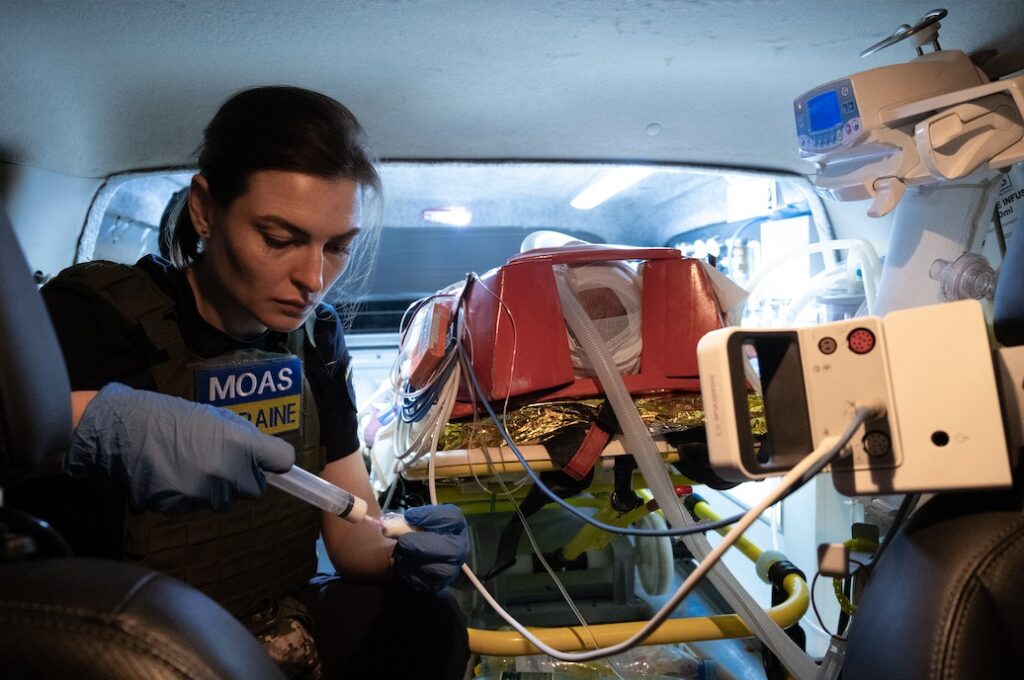
The female healthcare workers in our frontline team in Ukraine exemplify dedication, compassion, and resilience in challenging environments. The all-Ukrainian team of 150 medical professionals, including doctors, nurses, paramedics, and drivers, operates a fleet of 52 state-of-the-art ambulances, providing critical care and medical evacuations directly on the frontlines. Women play crucial roles at all levels of our operation, challenging the notion that the frontline is exclusively a man’s domain.
One standout example is Alina Bilous, our team leader. Alina has been with MOAS since the mission’s inception, joining almost immediately after the full-scale invasion began. As the first Ukrainian-speaking team leader, she has been instrumental in coordinating our lifesaving efforts. Alina’s journey from training as a paramedic when the war was declared to leading our frontline operations exemplifies the dedication and resilience of our team.
Other women in our team take on various critical roles, from nurses and tactical medics to logisticians and anaesthesiologists. They work tirelessly in challenging conditions, often under the threat of missile attacks and artillery fire, to provide emergency medical care and evacuations. You can read about their stories in our book ‘Sirens of Hope’.
Supporting Women in Global Health
Numerous organisations worldwide are committed to supporting and empowering women in the global health sector. These organisations work to address gender inequities, promote leadership opportunities, and advocate for policies that benefit women in healthcare.
Here are several ways we can support women in global health:
- Advocating for gender-responsive policies
- Promoting women’s leadership in healthcare institutions
- Providing mentorship and networking opportunities
- Supporting education and professional development
- Addressing workplace discrimination and harassment
Examples of organisations making a difference include Women in Global Health (WGH), which advocates for gender equity in global health; the Alliance for Women’s Health and Prevention (AWHP), which works to ensure women and girls have access to high-quality preventive care; the Society for Women’s Health Research (SWHR), which identifies research gaps, raises awareness of conditions affecting women and fosters policies to shape positive health outcomes for women. Women in Healthcare promotes professional development through networking and mentorship. Of course, there are more that are not listed here.
The existence of these organisations shows that there is work to be done, but many are committed to doing this work.
Final Thoughts
The increasing presence of women in healthcare is reshaping the industry, bringing new perspectives and approaches to patient care. We can build more resilient, equitable, and effective health systems worldwide by continuing to celebrate and support women in healthcare. Women’s leadership and participation at all healthcare levels are beneficial and essential for achieving global health goals and improving health outcomes for all.
As we move forward, let us recognise and applaud the invaluable contributions of women in healthcare. Their unwavering commitment to saving lives and providing care in the most challenging circumstances truly makes them heroes.
Your support can make a difference. Please consider donating to help us continue our missions and save lives. Visit www.moas.eu/donate to contribute. For more updates on our work, follow us on social media, sign up for our newsletter, or contact us at [email protected].
Funded by the European Union. Views and opinions expressed are however those of the author(s) only and do not necessarily reflect those of the European Union or the European Education and Culture Executive Agency (EACEA). Neither the European Union nor EACEA can be held responsible for them.