
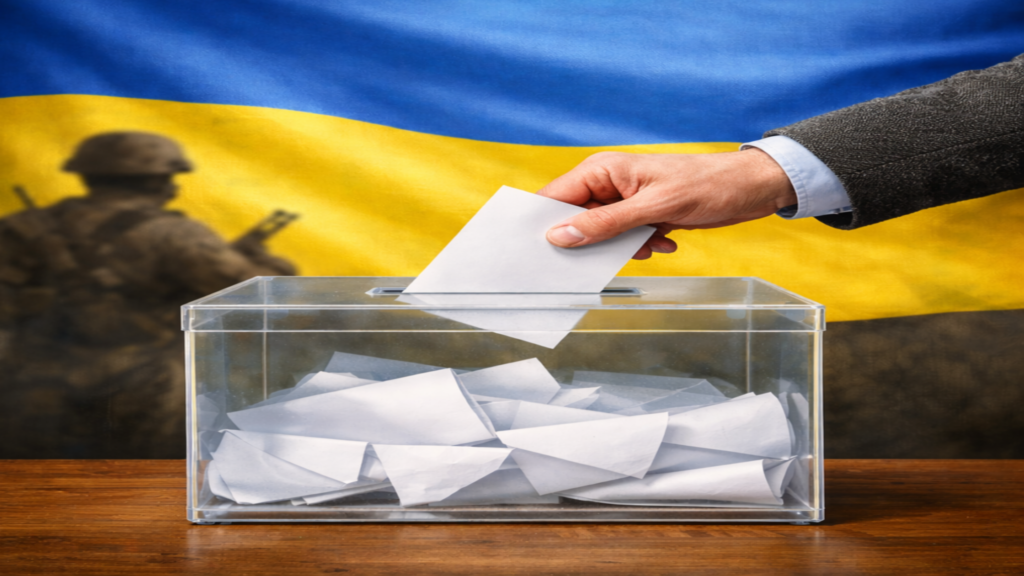
“There is more to democracy than just free and fair elections, but there can be no democracy without them.“
Constant vigilance is required to protect democracy from the threats it faces, which range from old-fashioned fraud on election day to media manipulation and regulatory obstacles during the campaign period.
The situation is further complicated during instability and times of war, when it becomes incredibly difficult to hold democratic elections.
In Haiti elections haven’t been held since 2016 in part due to the massive levels of gang-related violence that perpetuated the country’s political crisis. Ongoing conflict also resulted in the postponement of elections in South Sudan and Ukraine in 2024 due to threats of violence.
The Case of Ukraine
President Volodymyr Zelenskyy was directly elected in 2019, and his mandate was supposed to end in the spring of 2024, when presidential elections were expected.
However, immediately after the Russian invasion of Ukraine in 2022, president Zelenskyy declared martial law, which constitutionally prohibits holding elections in order to ensure continuity of governance and support the nation’s defense.
Parliamentary elections scheduled for October 2023 were also postponed, with all parties in parliament agreeing that the poll would take place six months after the end of martial law.
Since 2022, other political rights and civil liberties have been restricted in Ukraine, motivated by concerns for security and the high risk of foreign interference or intelligence gathering through vulnerable pathways, which may put citizens at risk. For example, prior to the latest Russian invasion there were no formal barriers to the creation and operation of political parties, with the exception of the Communist Party. However, in May 2022 Zelenskyy signed a law that banned all political parties that justify, recognize as legitimate or deny Russian aggression against Ukraine. As a consequence, more than a dozen parties were identified as “pro-Russia” and banned, including the largest opposition party, the OPZZh.
Under another presidential decree from 2022, Ukraine’s main news channels broadcast only government-approved content and give airtime predominantly to ruling-party representatives in order to limit opposition parties’ exposure.
While these measures were justified by the government as necessary for national security, they significantly narrowed the space for political competition and pluralism, raising concerns about the long-term health of Ukrainian democracy.
Why did Ukraine Postpone Elections?
Beyond the legal prohibition imposed by martial law, the Ukrainian government identified three major obstacles to holding elections during the Russian invasion: security risks, financial constraints, and mass voter disenfranchisement.
First of all, the paper-ballot voting process would provide highly vulnerable targets to the Russians, such as polling stations (usually schools), electoral administration offices, printing presses, and delivery vans transporting ballots. An electronic-voting system has been suggested, but introducing it would require the parliament’s approval, and it would need to be designed so that every Ukrainian citizen can participate, including people without mobile devices or internet signal. Nevertheless, an e-voting system would still be vulnerable to Russian hacking campaigns.
Secondly, the presidential election is expected to cost US$200 million, and parliamentary elections another US$135 million. Under normal circumstances, this would be a small percentage of the national budget, but at the moment the state is directing all resources to the war and the subsequent humanitarian-relief efforts. Therefore, justifying such an expense to citizens would be extremely difficult, especially since previous protests regarding municipal spending on construction projects rather than military defense have already taken place.
Lastly, the most important reason for not holding elections is that a great part of the country’s population would face enormous challenges participating. Around 6.5 million Ukrainians live abroad (with over a million residing in Russia), around 5 million live in Russian-occupied territories, nearly 4 million are internally displaced, and a million are active military personnel.
For all these people to vote, they would need to be registered, which would be effectively impossible in Russia or in areas under Russian control. Regarding military personnel the registration process would be easier, but arranging a free and fair vote on the frontlines wouldn’t.
Finally, the Ukrainian-controlled territories are subjects of active warfare where missiles and other attacks happen almost daily. In these areas, voter turnout would be low, and this would systematically underrepresent those people most directly affected by the war. Therefore, any winner of such an election might be considered illegitimate by some parts of the population.
Consequences of Lack of Elections
Despite the presence of martial law, renewed every 90 days through parliamentary votes, Ukraine remains quite pluralist given the circumstances. However, the impact of the suspension of civilian control has real impacts: with postponed elections and a number of pro-Russian parties banned, the opposition’s ability to compete for power is very limited.
Freedom of speech and independent press have also been constrained by the government’s control over media. Even though political opposition parties have access to other channels of influence like social media, the access to information in Ukraine can’t be defined as unbiased.
The long-term effect of postponing elections is also affecting the number of deputies in the parliament. In fact, elected parliamentarians who retire cannot be replaced without new elections, which causes a slow but steady decline in the number of deputies. Despite this situation being a long-term problem, at some point the parliament may lack a quorum, hence postponing elections can’t be a long-term solution.
However, to plan any election in the above-described circumstances, a tremendous amount of preparation is required to overcome and mitigate the problems that are now obstructing the ability of citizens to vote.
8 Standards for Free and Fair Elections
For a country to truly be a democracy, its elections must be both free and fair. According to widely accepted democratic principles, elections must meet a set of minimum standards to be considered free and fair. These standards extend beyond election day itself and depend on the broader political environment that must be vibrant and free from government interference.
Here are the eight crucial standards elections must meet in order to be considered free and fair:
- Voter registration: all citizens who meet the eligibility requirements (for example, being above a certain age) need to be able to register to vote.
- Voters have access to reliable information to make informed choices at the ballot box.
- Citizens who are eligible to vote should be eligible to run for office.
- All voters are able to vote: voters should not be overly burdened to reach polling places, with special attention paid to citizens with disabilities, health conditions or lack of transport.
- Voters are not intimidated or threatened at any point during elections.
- Voting is free from fraud: every eligible voter should be able to cast one ballot, and it should be counted the same as every other ballot.
- Ballots are counted accurately and the correct results are reported. Ballots must not be altered or thrown out after they are cast. And when a fair count is done, the government cannot refuse to release it or release a different result.
- The results are respected.
In Ukraine’s current wartime context, meeting these standards would be extraordinarily difficult, if not impossible.
Viewed through these standards, Ukraine’s postponement of elections appears not merely as a legal consequence of martial law but as a recognition that elections held under current conditions would fail to meet the minimum requirements of democratic legitimacy. Holding a vote that systematically excludes millions of citizens and restricts political pluralism could ultimately undermine, rather than strengthen, democratic governance.
Final Thoughts
As Freedom House documented in 2024, violent conflict has driven some of the steepest global declines in freedom, eroding both political rights and civil liberties.
Ukraine illustrates the central dilemma facing democracies at war: while postponing elections may be necessary to preserve national survival, prolonged suspension risks weakening democratic accountability and institutional legitimacy. War time governance requires constant vigilance, not only to defend territory, but to safeguard the democratic foundations that the war is being fought to protect.
Your support can make a difference. Please consider donating to help us continue our missions and save lives. Visit www.moas.eu/donate to contribute. For more updates on our work, follow us on social media, sign up for our newsletter, or contact us at [email protected].

Disclaimer: “Funded by the European Union. Views and opinions expressed are however those of the author(s) only and do not necessarily reflect those of the European Union or the European Education and Culture Executive Agency (EACEA). Neither the European Union nor EACEA can be held responsible for them.”