
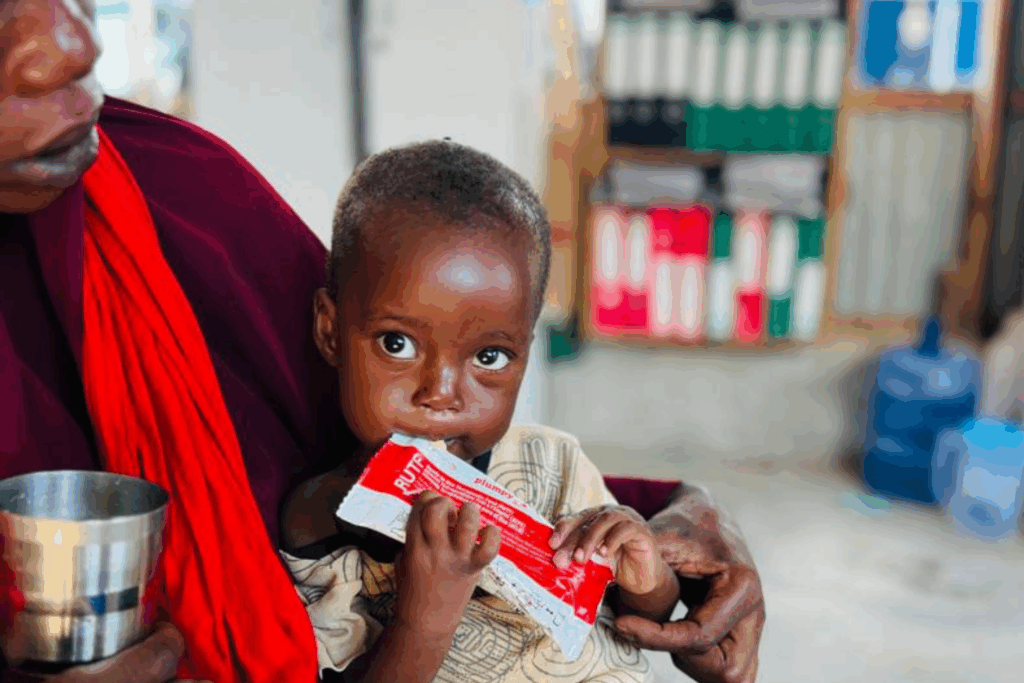
This year’s World Food Day carries a special weight: it marks the 80th anniversary of the Food and Agriculture Organisation of the United Nations (FAO), founded in 1945 with a simple but urgent mission to end hunger and improve nutrition and food security across the globe. Eight decades on, the challenges remain immense, as many countries face hunger, food shortage and increased malnutrition. This week, we want to shed light on the situation in Somalia, where the urgency is greater than ever.
In Somalia, the struggle for food security reflects some of the deepest humanitarian challenges of our time: climate shocks, conflict, displacement, economic hardship, and insufficient funding. On this World Food Day, Somalia reminds the world why the fight against hunger demands renewed determination and shared responsibility more than ever before.
Somalia: At the Epicentre of Food Insecurity
Somalia is among the countries most severely affected by food insecurity globally. In recent months, the projections are bleak:
- An estimated 4.4 million Somalis are projected to face acute food insecurity by the end of 2025, up from about 3.4 million currently.
- Children are especially vulnerable: approximately 1.85 million children under five years are likely to suffer from acute malnutrition.
- Of these, some 466,000 children will face severe acute malnutrition (SAM), while about 1.2 million will suffer from moderate acute malnutrition (MAM).
Somalia’s hunger crisis is not the result of a single catastrophe, but rather a convergence of shocks that continue to tighten their grip on the country. Drought, once cyclical, has become constant. Season after season, the rains fail or arrive with destructive force, washing away topsoil, drowning crops, and leaving vast stretches of land barren. Floods and dry spells now follow one another in cruel succession, eroding livelihoods that depend almost entirely on the land and livestock.
Conflict makes the struggle even harder. Insecurity has pushed millions from their homes – farmers who can no longer plant, herders who have lost their animals, families forced to abandon everything in search of safety. Nearly four million Somalis are now displaced, many living in fragile camps where food, clean water, and healthcare are scarce luxuries.
Even for those who remain in their communities, food is slipping further out of reach. Prices for staples like sorghum and rice have soared, driven by conflict, poor roads, and volatile trade routes. The market shelves may not be empty, but for many Somalis, they might as well be – the cost of a single meal can now exceed a family’s daily income.
Malnutrition tells the most painful story of all. In parts of southern Somalia, clinics report growing numbers of children suffering from acute hunger. Their weakened bodies are further ravaged by disease outbreaks and unsafe water, turning a food crisis into a health emergency.
And behind it all lies a quieter, more devastating force: a lack of funding. Humanitarian agencies warn that vital programs are running out of money, forcing impossible choices about who gets help and who must wait. In Somalia, waiting can mean the difference between recovery and ruin.
The Human Face of Hunger
Somalia’s hunger crisis is eroding daily life. Pastoralist families are losing everything: in Somaliland’s Sanag region, 60% of animals have died after years of failed rains, while in Mudug, former herders turn to fishing out of necessity. In the south, parents send children to school without breakfast and stretch meagre, low-nutrient staples as food prices rise. Clinics at the front line are overwhelmed as malnutrition collides with diarrhoea, cholera, and respiratory infections, fuelled by scarce clean water and sanitation—especially in displacement camps where unreliable supplies speed disease transmission. Women, particularly pregnant and nursing mothers, bear the heaviest load, often skipping meals for their children and growing weaker as they juggle hunger, illness, and caregiving. The picture is stark: livelihoods are collapsing, health systems are strained, and families are forced into impossible choices just to get through the day.
Yet there are glimmers of hope.
MOAS: Bringing Life and Hope to Somalia’s Children
Since 2020, MOAS has been on the frontlines in Somalia, tackling one of the world’s most urgent humanitarian crises: child malnutrition. In partnership with Edesia and local organisations, MOAS ships therapeutic food, highly fortified nutritional supplies specifically designed to treat acute malnutrition in children under five. These life-saving deliveries reach some of the most remote and vulnerable communities, where access to healthcare, clean water, and food is critically limited. The mission goes beyond immediate relief.
By providing targeted support, MOAS helps families recover their strength, protects children’s growth and development, and restores a sense of hope in communities struggling to survive. Each shipment represents more than nutrition – it is a tangible message that the world has not forgotten them, and that solidarity and coordinated action can make a real difference.
Through these efforts, MOAS demonstrates that even in the face of extreme adversity, compassion, partnership, and decisive action can save lives and empower communities to rebuild their futures.
Final Thoughts
World Food Day reminds us that hunger is not an unavoidable fate. It is a challenge we can overcome together. Today, the situation in Somalia underscores both the magnitude of this challenge and the resilience of communities that refuse to give up. Families stretch insufficient meals, rebuild livelihoods after droughts and floods, and adapt to a changing climate, demonstrating remarkable courage in adversity. At MOAS, we strongly believe that no child should go to bed hungry, no farmer should be without tools to recover, and no community should be overlooked. We are dedicated to providing aid and support to the starving population as much as possible.
Because ending hunger is not just a goal – it is a moral imperative. And together, we can make it happen.
Your support can make a difference. Please consider donating to help us continue our missions and save lives. Visit www.moas.eu/donate to contribute. For more updates on our work, follow us on social media, sign up for our newsletter, or contact us at [email protected].


Disclaimer: “Funded by the European Union. Views and opinions expressed are however those of the author(s) only and do not necessarily reflect those of the European Union or the European Education and Culture Executive Agency (EACEA). Neither the European Union nor EACEA can be held responsible for them.”